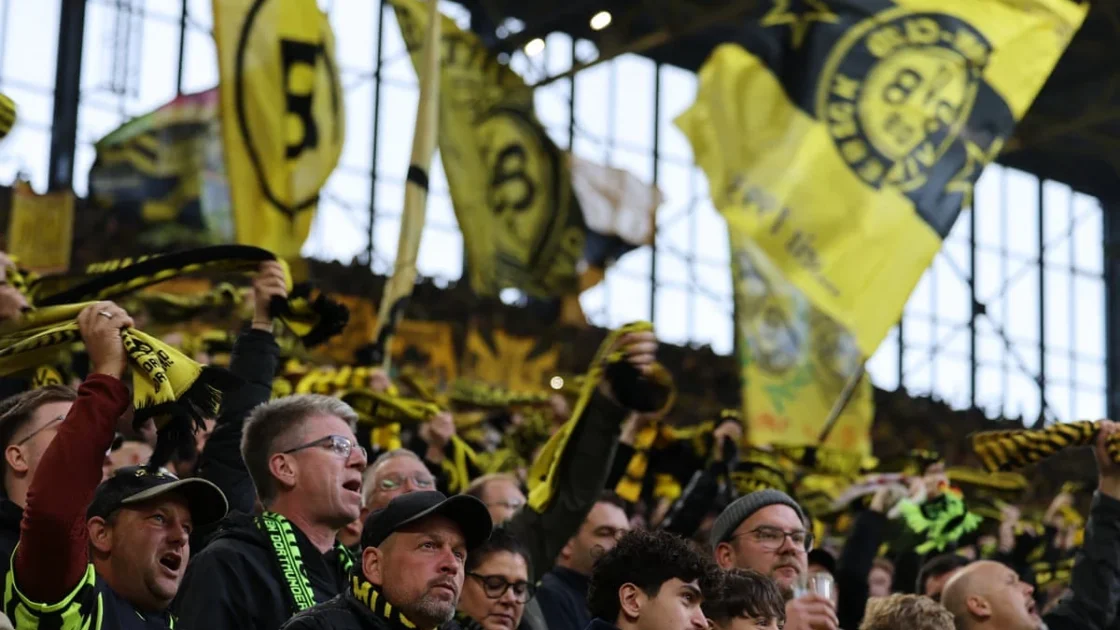
Borussia Dortmund recently introduced a rewards program to encourage fans to stay off their phones during matches. While sports teams increasingly battle against commercial influencers in stadiums, Dortmund’s move raises deeper questions about whether clubs should dictate how ticket-buying fans experience games.
The Battle Against Phones and Influencers
On the surface, the atmosphere at Signal Iduna Park appeared completely unchanged last Saturday. Tens of thousands of fans on the Yellow Wall waved flags and chanted as the stadium announcer read the starting lineup. The sold-out crowd of 81,365 fans later roared when Max Beier scored the lone goal that secured a victory over Eintracht Frankfurt, placing Dortmund even on points with Bayern Munich at the top of the Bundesliga standings.
Just before the match, however, Dortmund rolled out a rewards program aimed at curbing phone usage. Fans who kept their phones in their pockets during the game had the chance to win signed jerseys and merchandise gift cards. By activating a “fan mode” on the club app, the team could track which supporters unlocked their phones the least, awarding points for every minute the devices went untouched.
Dortmund is not alone in tackling the issue of mobile devices in stadiums. Second-division German clubs Hertha Berlin and Dynamo Dresden have banned commercial influencer-style videos entirely to protect TV rights and fan experiences. Dortmund appears similarly motivated by influencers who monetize footage of match days and disrupt regular attendees. Major tennis tournaments have faced similar challenges, with the US Open dealing with disruptive content creators and Wimbledon refusing to credential them.
The Debate Over Fan Expectations
Dortmund’s initiative goes beyond merely blocking content creators, raising questions about how sports should be consumed. Dortmund chief executive Carsten Cramer stated that over 81,000 people singing and cheering together represents an irreplaceable here and now that the club wants to put front and center. Marcel de Groot, the chief executive of Vodafone Germany—a club sponsor and mobile provider—added that soccer attendees should experience moments and emotions rather than a cell phone screen.
These efforts highlight a broader dilemma for professional sports: do teams have the right to dictate how supporters experience matches? This mirrors challenges faced by musicians performing to crowds obscured by glowing screens. The situation forces a reexamination of whether live soccer is simply entertainment where consumers can behave as they please, or if active participation and community membership come with specific behavioral expectations.
American sports leagues often feature less organically engaged crowds prompted by jumbo screens, a sharp contrast to global football culture driven by supporters. Because Bundesliga ownership rules have largely preserved supporter culture and affordable tickets, Dortmund has long been a model for fan engagement, naturally drawing the attention of influencers. While interlopers will likely be dealt with, correcting the behavior of traditional fans through club-mandated rules remains a much more complicated challenge.
Source: Football | The Guardian