Barcelona supporters have long mocked Jose Mourinho by calling him a translator, referencing his early days serving as an interpreter for Sir Bobby Robson. Starting with Benfica in 2000, Mourinho evolved into a two-time Champions League winner with managerial success across England, Italy, and Spain. His career highlights qualities like diligence, tactical brilliance, and an ability to thrive in chaos.
Masterclass Against Barcelona
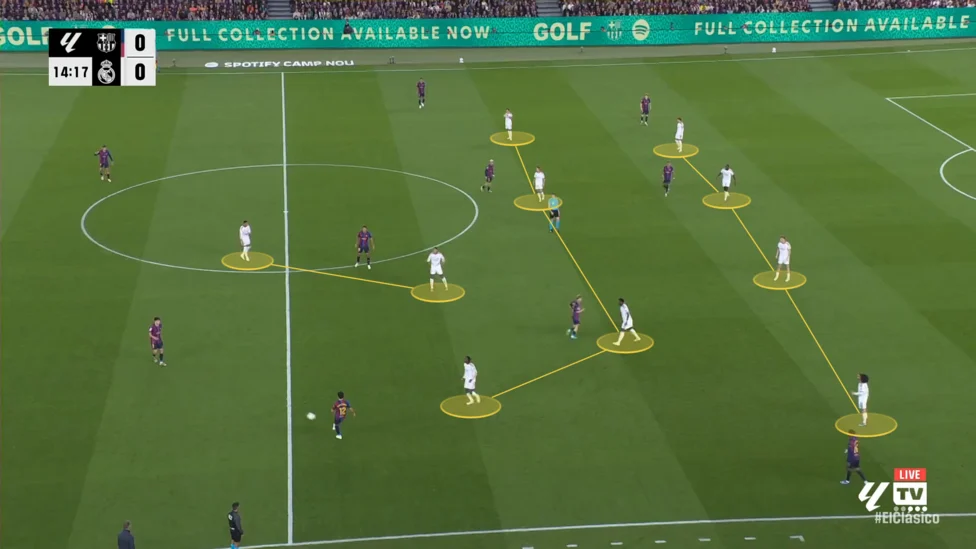
Last weekend, Mourinho showcased his tactical mind as Real Madrid defeated Barcelona 2-1 in El Clasico. Real lined up in a 4-4-2 formation without the suspended Vinicius Jr, deploying Federico Valverde at right-back, Bernardo Silva alongside Aurelien Tchouameni in midfield, Arda Guler and Yan Diomande on the flanks, and Jude Bellingham supporting Kylian Mbappe up front. Silva was tasked with man-marking Pedri to reduce the midfielder’s impact on the game.
Real players drew opponents in wide areas to exploit the space opening up on the opposite side through long switches or dribbling. This tactic was especially visible when the ball moved from the right flank to the left where Marc Cucurella sneaked behind Lamine Yamal. After the match, Mourinho explained that deep runs from his midfielders created the biggest problems for Barcelona’s high defensive line, dismantling Hansi Flick’s front-footed approach.
Tactical Periodisation and Adaptability
While coaches with fixed positional references and defined patterns have been praised as tactical geniuses, Mourinho relies on player quality and adaptable tactics that vary by club. As reported by The Athletic, Mourinho’s training sessions at Real Madrid this season are shorter, more intense, and always include the ball, even for match fitness work.
Mourinho follows tactical periodisation, a philosophy pioneered by Vitor Frade during their time together at Porto in the 1990s. This methodology rejects the separation of technical, tactical, physical, and psychological elements, viewing them as inseparable during a match. Followers of this approach accept and adapt to match chaos rather than trying to minimize it.
Navigating the Chaos of Modern Football
Between 2019 and 2025, Mourinho took charge of clubs with more modest expectations, winning the Europa Conference League with Roma in 2022. During that decade, managers who kept high possession and deployed symmetrical shapes with zonal defenses found the most success. However, the recent rise in man-to-man pressing has removed easy overloads and increased match chaos.
This evolving landscape benefits Mourinho, whose holistic training prepares players to solve problems on the fly rather than following rigid patterns. Against Barcelona, stars like Bellingham, Mbappe, and Silva excelled by playing in their own styles that converged under high stakes. With managerial sequels defining his career—including returns to Benfica, Chelsea, and now Real Madrid—the changing tactical landscape may offer him another successful chapter.
Source: BBC Sport