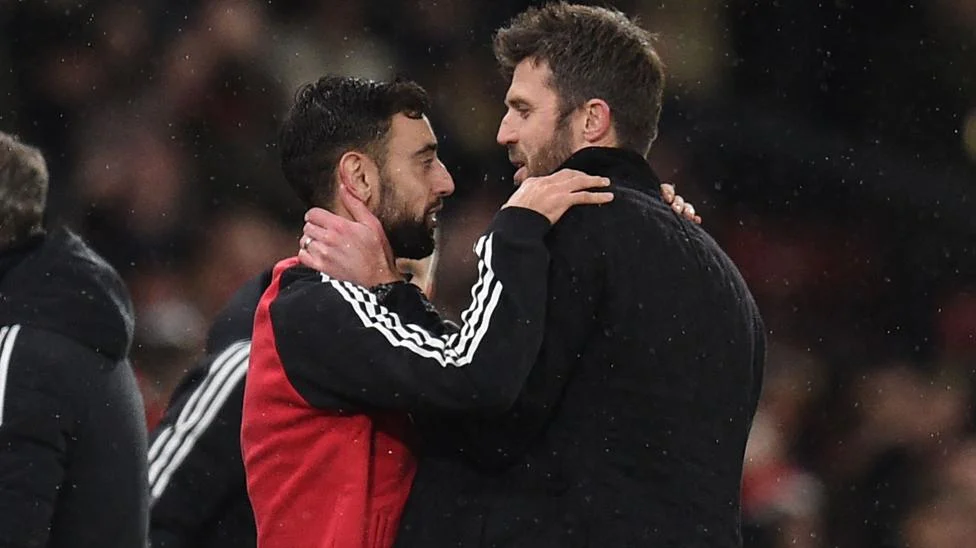
Manchester United captain Bruno Fernandes appeared to question the team’s tactical setup following a 4-1 Champions League defeat by Como on Wednesday. The Portuguese midfielder pointed to a decision by the coaching staff to avoid man-to-man pressing, which he argued allowed opponents too much comfort on the ball.
Was Fernandes’ analysis accurate?
Since Michael Carrick took charge as manager in January, Manchester United have primarily defended in a zonal 4-2-4 or 4-4-2 shape that triggers a press at specific moments. When Fernandes mentioned that United leave space behind to try and win the ball back initially, he was describing a system that avoids an immediate, pitch-wide man-to-man press.
By holding a slightly deeper 4-2-4 shape, the team grants opposition defenders time and space while setting traps. With four players positioned narrow and high, attackers are meant to be primed for quick counter-attacks upon recovering possession. This setup yielded positive results during Carrick’s caretaker stint last season, such as a 3-2 victory at Arsenal in January.
However, this strategy has proven less effective this current season. Reflecting on a broader need for evolution, defender Lisandro Martinez noted after a 2-0 defeat by Atletico Madrid that teams study past approaches and make staying static problematic. AC Milan, now managed by former United boss Ruben Amorim, repeatedly bypassed United’s 4-2-4 shape by utilizing a back five that outnumbered the forward line, forcing wingers and full-backs to cover excessive ground.
Similar vulnerabilities emerged against Atletico Madrid, where a back four left an extra attacker high up the pitch and forced United’s midfielders to cover vast distances. This dynamic aligned with Fernandes’ observation that opponents make the team run extensively, leading to on-field frustration.
Why is Carrick taking this approach?
When these remarks were presented to Carrick after the match, he defended his methods by noting that a brief shift to a half-man-to-man press in the second half resulted in conceding another goal. He emphasized that regardless of the chosen system, winning requires maximum running effort.
The less aggressive 4-2-4 formation provides a numerical advantage in the backline and aims to funnel opposing attacks toward the flanks. Furthermore, United’s defenders have previously struggled to win one-on-one duels when committing to a full press. Attempts at a man-to-man press in the Premier League have also fallen short due to execution errors.
What can United do?
Questions remain over whether Carrick’s squad possesses the physical fitness and sustained intensity required to execute a high man-to-man press comparable to physically disciplined sides. A visible disconnect between Fernandes’ perspective and the coaching staff’s messaging complicates the execution of any defensive plan.
Fernandes stressed the need for greater bravery and higher pressure to make opponents uncomfortable. Conversely, Carrick’s deployment of four forwards ready for rapid counter-attacks represents an alternative strategic risk. While a half-man-to-man approach attempts to balance zonal and aggressive defense, United’s current application of the 4-2-4 shape appears exposed, suggesting any path to regular victories will require a compromise between the captain’s and manager’s viewpoints.
Source: BBC Sport