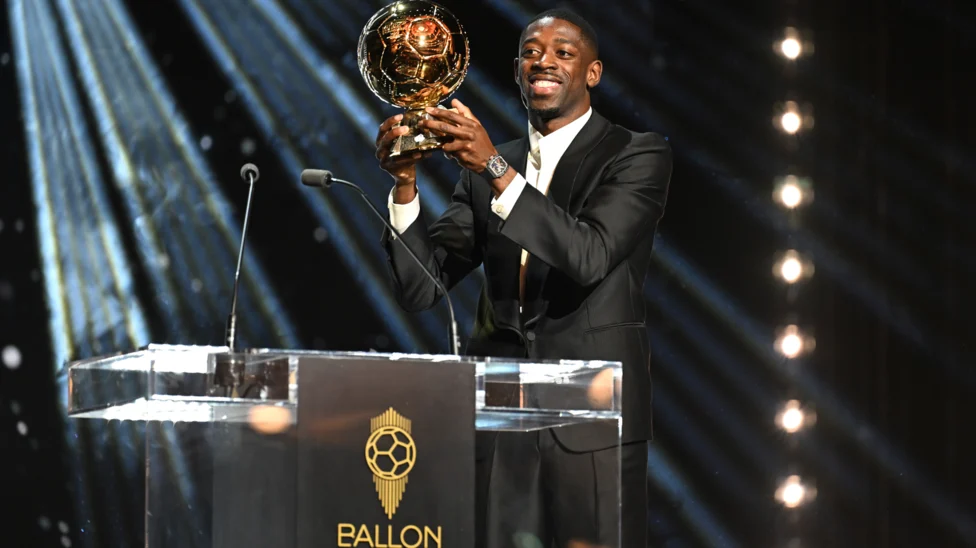
The race for the men’s Ballon d’Or has increasingly transformed into a high-stakes campaign resembling a political election, driven by intensive public relations efforts from clubs, players, and entourages. Following last year’s ceremony in Paris, the global spotlight immediately turned toward who might claim the prestigious individual football accolade in a major tournament year.
The Lobbying Machine and Media Noise
European football expert Guillem Balague told the BBC Sport Euro Leagues podcast that the award reflects modern society’s focus on individual brilliance over collective success. French football journalist Julien Laurens highlighted the powerful PR machines utilized by clubs and players to sway opinion as the red-carpet event approaches.
Managers and sporting directors frequently advocate for their players or voice frustration over omissions. Barcelona director Deco described the exclusion of Raphinha and Pedri as a huge scandal, while backing Lamine Yamal as his favorite. Yamal stated he would not beg for the prize, and Paris Saint-Germain manager Luis Enrique admitted he is bored of the debate, despite having a record 10 players on the shortlist.
Other contenders have been more direct. Real Madrid forward Kylian Mbappe, compared by boss Jose Mourinho to the original Ronaldo, acknowledged his ambition to win the award for the first time. Meanwhile, Bayern Munich board member Max Eberl argued that the best players do not need to run campaigns. Former winner Jean-Pierre Papin criticized Mbappe’s approach as overly self-focused, though Mbappe noted that the trophy is traditionally reserved for players who stand out, echoing the dominant era of Lionel Messi and Cristiano Ronaldo.
Sports brand strategist James Kirkham compared the buildup to an election campaign involving canvassing and securing voting blocks from different countries. Since 2015, the winner has been decided by a panel of one journalist from each of the top 100 FIFA-ranked nations, evaluating a 30-player shortlist compiled by France Football and L’Equipe.
The Social Media Era and Changing Fan Culture
Former AC Milan chief executive and sporting director Ariedo Braida observed that modern football moves at the speed of light, with fans increasingly following individual players rather than clubs. Kirkham noted that relentless social media noise amplifies viral clips, opinions, and narratives across platforms, creating an ecosystem that continuously builds up or tears down players.
This intense focus contrasts sharply with past eras. Michael Owen recalled that when he won the award in 2001 at age 22, he barely knew what the Ballon d’Or was. Originally restricted to European players until 1995 and European-based clubs until 2007, the prize has evolved into a truly global event with a glamorous ceremony established in 2011.
Commercial Impact and Past Controversies
Winning the accolade carries massive financial and commercial benefits for both players and clubs. Braida explained that AC Milan signed Kaka for about 7.5 million euros and later received a written offer of 105 million euros from Manchester City following his 2007 Ballon d’Or win, demonstrating how the honor multiplies a player’s global exposure and valuation.
England captain Harry Kane emerged as a strong contender for the current prize, with figures like Rio Ferdinand publicly championing his case. Bayern Munich has not produced a winner since Karl-Heinz Rummenigge in 1981. The club also remembers Robert Lewandowski, who missed out when the 2020 ceremony was cancelled due to the Covid-19 pandemic, later describing the accolade as partly political and commercial.
Controversies and snubs frequently ignite intense global reactions, such as Franck Ribery describing his 2013 defeat as a robbery, and Real Madrid boycotting the 2024 ceremony when Rodri won ahead of Vinicius Junior. Globo international football reporter Caique Andrade noted the massive commotion this caused in Brazil.
Kirkham concluded that the global reach of the award generates larger audiences, greater visibility, and increased financial returns worldwide.
Source: BBC Sport